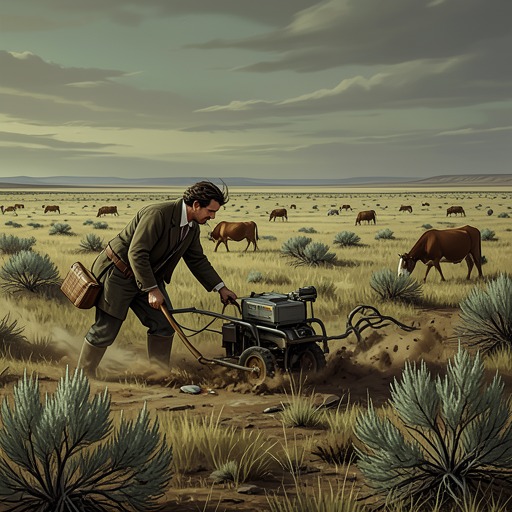
Sagebrush eradication campaign on Western ranchlands
Silent SpringThe sagebrush eradication campaign on Western ranchlands sought to replace sagebrush with grass for cattle, but Carson presents it as a high-stakes remaking of an arid ecosystem, not a simple improvement in grazing. Across millions of acres, chemical spraying joined cutting, plowing, and seeding in a campaign that threatened the plants, animals, and water-holding conditions that made the land viable in the first place.
A Landscape Shaped by Sage
The campaign’s stakes begin with the character of the country itself. The sage lands of the high western plains and the lower mountain slopes were shaped by harsh climatic extremes and long processes of natural adaptation. Sagebrush was not an unwanted obstruction in an otherwise unfinished pasture. It was part of the structure through which the land supported other vegetation and animal life.
Carson describes animals as having evolved in harmony with the demanding habitat. The swift pronghorn antelope and sage grouse were among the creatures closely adjusted to it. Perennial bunchgrass grew in the shelter of sage, while the sage itself held moisture. The existing landscape was therefore not simply sage instead of grass: it included grass growing among and beneath sage, a relationship that mattered to the land’s capacity to support vegetation.
The Drive to Replace Sage
In the name of progress, land-management agencies set out to meet cattlemen’s demand for more grazing land. The desired result was grassland without sage. That goal treated the native plant as an obstacle, even though the region’s conditions favored bunchgrass sheltered by sage rather than the sod-forming grasses sought for replacement pasture.
The eradication campaign had been under way for years, with several government agencies involved and industry promoting the enterprise. Its commercial appeal extended beyond grass seed to the machines used to cut, plow, and seed the land. Chemical spraying became the newest addition to these methods. By the time Carson describes the program, millions of acres of sagebrush lands were being sprayed each year.
Costs to Wildlife and Livestock
The effects of eliminating sage and seeding grass were not yet fully known. Carson contrasts that uncertainty with the accumulated experience of people familiar with the land: they reported better grass growth between and under sage than could be achieved in pure stands after the moisture-holding shrubs were removed. The campaign’s immediate aim thus risked undermining the very conditions on which successful grass growth depended.
Even if the program achieved its short-term objective, Carson argues, it would tear apart a closely connected ecological system. Antelope and grouse would disappear along with the sage; deer would suffer as well. The harm would reach livestock, too. Green summer grass could not compensate for sheep left without sage, bitterbrush, and other wild vegetation during winter storms. What appeared to be a benefit to cattle raising could therefore become a seasonal liability to animals dependent on the plants the program removed.
The Wider Meaning of Chemical Eradication
Carson also places sagebrush removal within a broader criticism of indiscriminate chemical treatment. Spraying aimed at one target could eliminate many plants that were not targets at all. In an example she draws from William O. Douglas’s account of the Bridger National Forest, about 10,000 acres of sage lands had been sprayed after pressure from cattlemen. The herbicide’s reach was not confined to sage: willows were killed, and with them the habitat on which beavers depended. When Douglas visited in 1959, the year of the spraying, he saw shriveled and dying willows; the altered area had previously offered fishing and hunting as well as habitat.
The campaign’s significance lies in the gap between a narrowly stated management objective and the consequences across a living landscape. More grass was treated as synonymous with improvement, while the relationships among sage, moisture, wildlife, and livestock were discounted. Carson’s account makes those relationships central: a landscape cannot be judged only by the crop or pasture an intervention is intended to produce when the same intervention removes the ecological supports on which its inhabitants—including the intended beneficiaries—depend.